
NOT WORTHTHE DRIVE TODAY
That is a real sentence out of the app, and most weeks the right one. NORDR scores 65 cold-water breaks hour by hour, from De Panne to Unstad, and names the tide gate that opens the bank and the wind that shuts it.
THE CALL
ONE SENTENCE, THEN EVERYTHING BEHIND IT.
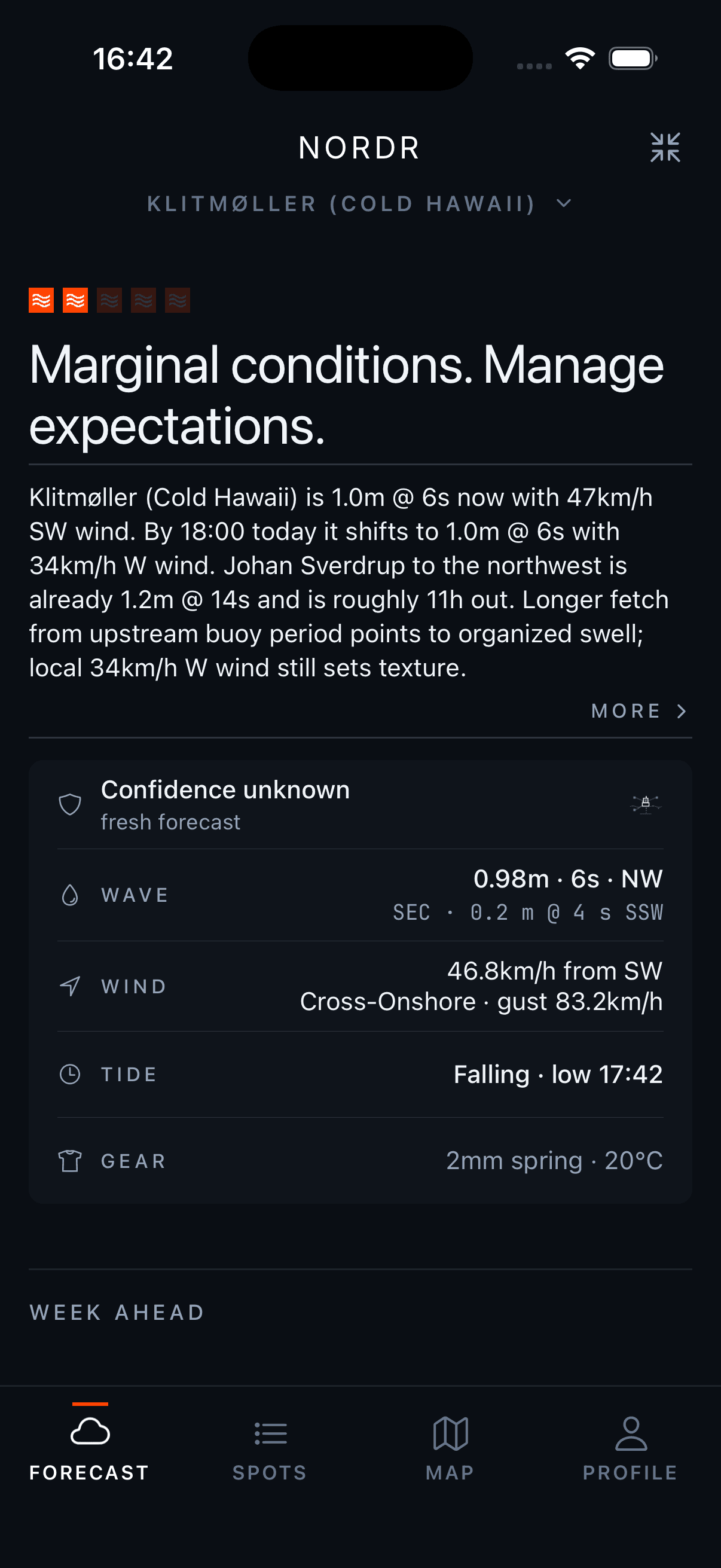
A written call for the break you picked. What the water is doing now, when it shifts, what is arriving from upstream, and where the tide sits. A five-step reading sits above it.
AND THE FOUR ROWS UNDER IT
- WAVE
- Height, period and direction, with the secondary swell underneath.
- WIND
- Speed and direction, and whether that reads offshore, cross-shore or onshore for the way this beach faces.
- TIDE
- Rising or falling, and the clock time of the next high or low.
- GEAR
- Water temperature and the suit for it, boardshorts through to a 6/5 hooded steamer.
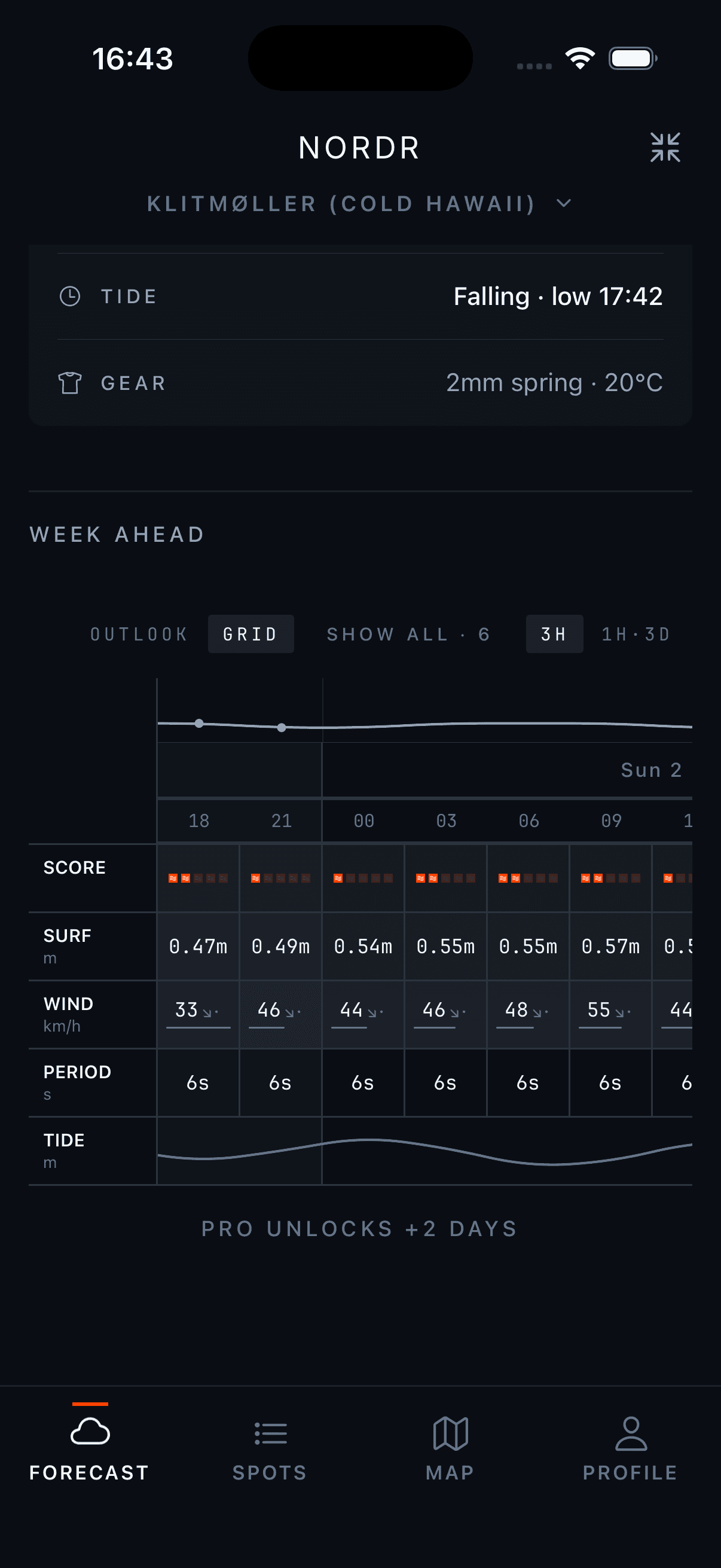
THEN THE WEEK, IN THREE-HOUR STEPS.
Score, surf height, wind, period and the tide curve across the week, hour by hour for the first two days. Free reads five days of it, Pro reads the last two as well. That grid is where the two hours worth driving for turn up, because on this coast that is usually all there is.
WHY THE WINDOWS ARE SHORT
HERE THE TIDE DECIDES WHETHER THERE IS A WAVE AT ALL.
Off Belgium the Flemish Banks sit in shallow water a few kilometres out. At low water they take the swell before it reaches the beach, so 1.2m at 10s on paper is ankle-deep sand in front of you. NORDR scores that in.
BELGIUM
De Panne to Knokke
Flat at low water. The outer banks take it first, and the window opens on the push.
NETHERLANDS
Domburg to Texel
About half the swell at low water. The bigger ones push through anyway.
DK · DE · SE · NO
Hanstholm to Unstad
Tide is not the limiter here, so it is not scored as one. Fetch and wind decide.
AND WIND IS SCORED AGAINST THE BEACH, NOT ON ITS OWN.
The same 30 km/h westerly is offshore at one break and straight onshore at the next one up the coast. NORDR reads it per spot, offshore through onshore, with the gust alongside it and the texture that follows.
Which is why a North Sea window is two hours and not two days, and why one forecast point for a whole coastline is the wrong unit.
YOUR BREAK
SIXTY-FIVE BREAKS IS NOT EVERY BANK ON THE COAST.
Drop a pin anywhere. Name it, say whether it is a beach break, a point or a reef, and pick the tide it works on. That pin gets the same hourly forecast as a listed break, at its own coordinates. Then you set the wind and swell directions that work there, and every forecast for it is scored against your windows.
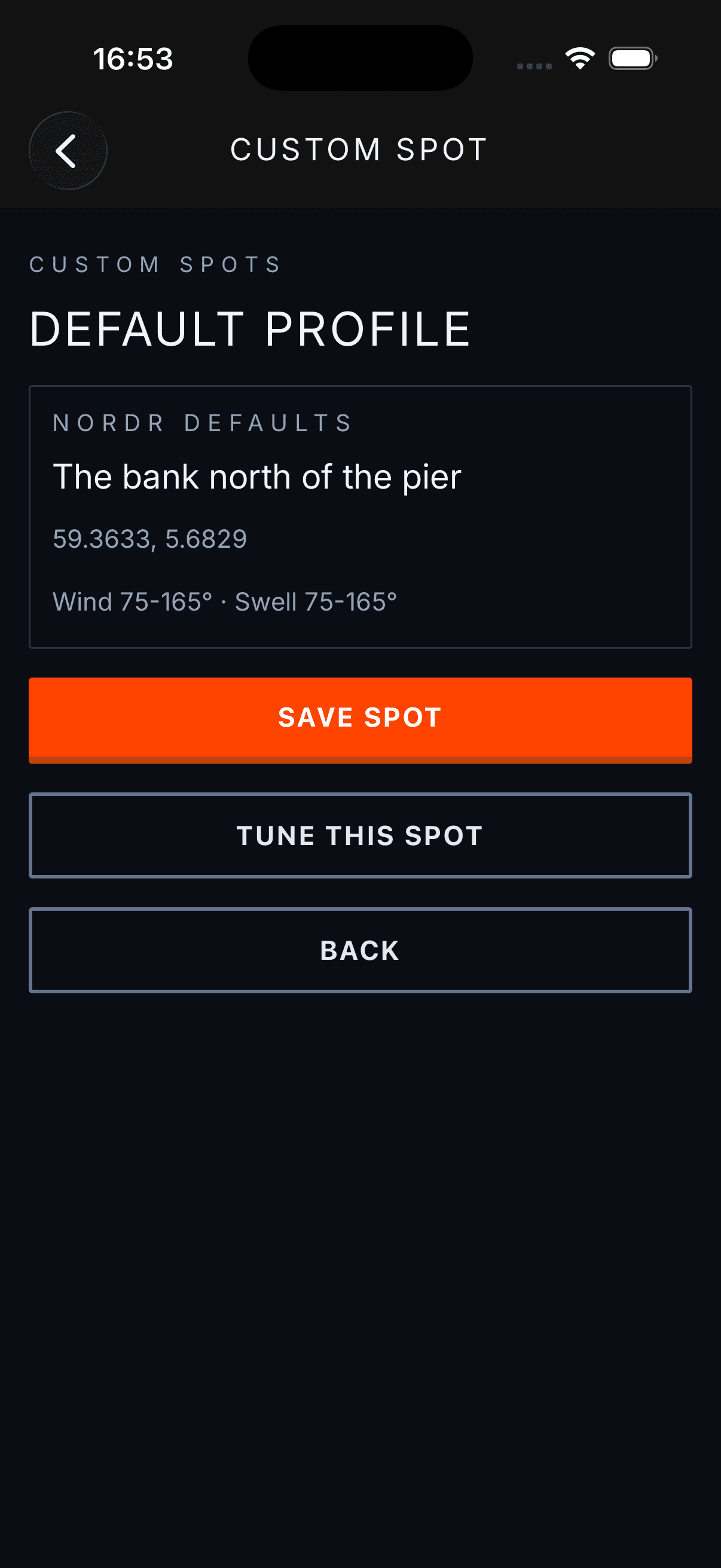
- 01PINAnywhere on the map. A nearby listed break gets you a warning, never a block.
- 02PROFILEBeach break, point break or reef, and the tide state it wants.
- 03WINDOWSDrag the wind and swell arcs until they match how it really works.
- 04SCOREDForecast, alerts and matching all run on your pin from then on.
A PIN YOU MADE HAS NO REPUTATION BEHIND IT.
So NORDR compares it live against the listed breaks under the conditions on the way, and gives you a match out of 100. Tide carries the most weight, then wave height, then swell direction. When your bank runs like one you already trust, you know what Saturday will feel like before you load the car.
Pins are free and unlimited. Free keeps one of them tuned, Pro keeps all of them.
THE LOOP
THREE SESSIONS AND IT STOPS USING THE DEFAULT.
Log a session and NORDR keeps the conditions itself: wave height, period, swell direction, wind, spot and time of day, straight off the forecast you just surfed. You add the half a forecast cannot know.
RATING
Out of ten, in half steps, while you are still in the car park.
BOARD AND SUIT
What you rode and what you wore. Longboard, midlength, fish, shortboard, step-up, soft-top.
CROWD AND SHAPE
Empty lineup through packed. Clean faces, peaky, running walls, punchy, soft, mixed, closing out.
OUTCOME
Hard work, mixed bag, fun session, scoring, all-timer.
AT THREE GOOD ONES, THE SPOT BECOMES YOURS.
Three sessions you rated well, inside two kilometres of the same spot, and NORDR drops its default idea of the ideal wave height and period there and uses the median of yours. The line on screen changes with it, from a match for the break to a match with your journal-shaped setup.
Five sessions in a rolling thirty days on free. Unlimited on Pro. The journal never leaves your phone.
NOBODY WATCHES A SEVEN-DAY GRID ALL WEEK.
Three rules run out of the box: tomorrow morning looks on, dawn patrol worth the early paddle, conditions just improved. They only fire when the score, the wave height, the wind and the size of the improvement all clear the numbers you set, so a marginal Wednesday stays quiet.
Score, wave height range, period, wind speed, wind zone, tide state, and how close conditions are running to your tuned pin. Across one break or across every spot you have saved. Set the lead time, the horizon and the quiet hours so it lands when it is still useful.
Alerts are scheduled on your own phone, not watched on a server.
COVERAGE
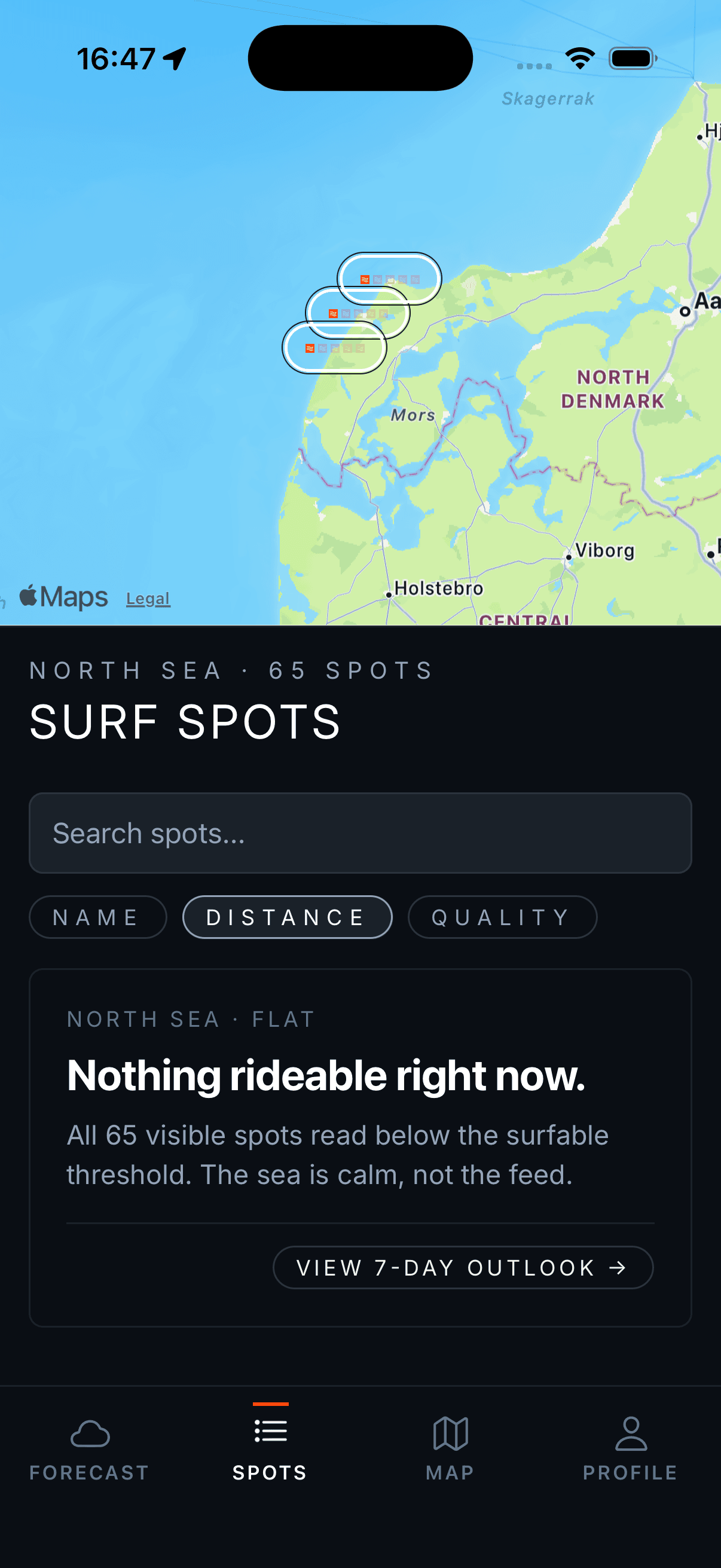
SIXTY-FIVE BREAKS. EIGHT COUNTRIES. NAMED.
Each one carries its own facing direction, break type, working tide and nearshore profile. Not a radius drawn around a weather grid point.
North Holland · South Holland · Zeeland · Wadden Islands
Jæren · Lofoten · Stadlandet · Vestfold
Cornwall · Yorkshire · Norfolk · Tyne and Wear
Belgian Coast
Opal Coast · Brittany · Gironde · Landes · Basque Country
North Jutland · West Jutland
Halland · Skåne
North Frisia · East Frisia
Not on the list? Pin it yourself, or tell us where you paddle out and we will look at the coast.
ACCESS
THE CALL IS FREE. THE BACK HALF OF THE WEEK IS NOT.
FREE
Enough to decide most days
- The written call and the five-step reading at all 65 breaks
- Five days of the grid, hour by hour for the first two
- Tide curve, swell trains, and the wave, wind, tide and gear rows
- Unlimited pins, one of them tuned
- Three automatic alerts and two of your own
- Five journal sessions in a rolling thirty days
PRO
For the ones who drive for it
- The last two days of the week
- Wind and swell breakdown, and the nearshore readout
- Break intelligence and the full dawn plan
- Spot optimizer: nearby breaks ranked against travel time
- Session match against your own journal
- Every pin tuned, unlimited alerts, unlimited journal
PRICE
€2.99 a month, or €19.99 a year with a seven-day trial. €59.99 a year covers five seats over Family Sharing. €79.99 once and it is yours.
PLATFORM
iPhone. Every break has a page on this site with the free five-day grid. Alerts, the journal and custom pins are in the app.
REQUEST COVERAGE
TELL US WHERE YOU PADDLE OUT.
New coasts go in where people actually surf. Say where and how often, and it goes on the list.
FAQ
STRAIGHT ANSWERS
Who is it for?+
Anyone who surfs this coast and plans around tide and wind. Beginners on a soft-top waiting for a clean waist-high push at Scheveningen, and people loading a step-up for the drive to Klitmøller. You name your boards and your level in the quiver, and NORDR names a board when the fit at a tuned spot is clear.
My break is not on the list.+
Pin it. A pin gets the same hourly forecast as a listed break, at its own coordinates, and you set the wind and swell windows yourself. Pins are free and unlimited. Free keeps one tuned, Pro keeps all of them.
How much of it is free?+
The call, the reading, the tide curve and five days of the grid at every break. Plus unlimited pins, three automatic alerts, two of your own, and five journal sessions a month. Pro is €2.99 a month or €19.99 a year.
Is there an Android version?+
Not yet. NORDR is on the App Store for iPhone. Every break has a page on this site you can read in any browser; alerts, the journal and pins are in the app.
Why does it tell me not to go?+
Because the drive is the expensive part. Ninety minutes each way for ankle-high closeouts is the failure mode NORDR is built around.